Posts for: #Utilities

SIP client for Android OS

Finally a SIP/VoIP program for the Android OS!

Sipdroid is a great GPL licensed program that allows you to make and receive SIP and make VoIP from your mobile. The app is incredibly simple to use, which just requires you to enter your SIP credentials (server, login and password).

Once it is on, you will see a little green bubble on the status bar indicating that you’re online. After that, just enter the phone number you’d like or use the phone numbers on your contact list, remembering to enter the country code.
[Read more]

Screencasting on Linux – recordMyDesktop

Doing a basic screencast in Linux is pretty easy. The package recordMyDesktop can be found easily on the repository of many Linux distros (including Ubuntu 9.04 that I use).

With this package you’re actually getting the backend recordMyDesktop which is written in C and the frontend developed in Python (gtk-recordMyDesktop or qt-recordMyDesktop).

The feature list is simple but that is all I needed for a quick screencast demo I had to prepare this afternoon:

[Read more]

Task manager [Android]

I’m an follower of GTD. Probably not the best one, but at least I try to keep myself as organized as I can in the stream of neverending to-dos.

Which is why one of the first applications I searched for to install on my Android device was a good task manager to sync with RememberTheMilk. I was quite happy to find the open source app Astrid. The program does exactly what I need:

[Read more]

Multiplatform desktop SVN

On Linux a nice small but highly effective tool I use to work with SVN is RapidSVN. The program is pretty small but highly effective for commit, checkout, merge, and log info.

RapidSVN works on Windows, Linux and MacOS X.

From their site, the list of features include:

  • Simple -easy to use for SVN features;
  • Efficient – simple for beginners but flexible enough for those experienced with Subversion;
  • Portable – runs on several platforms on which wxWidgets can run (Linux, Windows, Mac OS/X, Solaris, etc).
  • Fast – written in C++
  • Multilingual – translated to many languages: German, French, Italian, Portuguese, Russian, Ukrainian, Simplified Chinese, Japanese
[Read more]

eBook open standards

If you like to support open standards format, here is a (at least for me) new discovery:  .epub.

If you like open standards and ebooks, support the spreading of .epub. This file extension is a mixture of three open standards OPS ( Open Publication Structure ), OPF ( Open Packaging Format ) and OCF (Open Container Format ), produced by the IDPF.

From what I know Kindle – the hot ebook reader of the moment – does not support .epub format However, you can find some .epub ebooks in various websites, including Project Gutenberg. Viewing these files will be no problem with a software like FBReader.

[Read more]

Recover lost Windows passwords

Forgot your Windows login password? You can recover it easily with Ophcrack.

You can run Ophcrack through a live CD and have your passwords in no time. Or download the software to run on different platforms, even running in Windows itself if you have access to another user’s account.

Once downloaded, the software is incredibly easy to use and will recover the passwords of all users in your Windows installation, Windows XP or Vista.

[Read more]

Using rsync with no command like [linux]

For those (like me) who are interested on using rsync but are command line inexperienced, finding a GUI is a lifesaver.

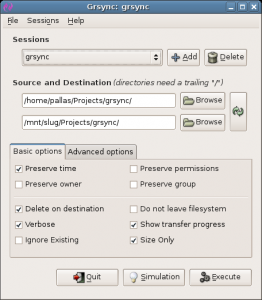
grsyncGrsync can make sure you use rsync without the terminal. The developers list several features such as:

  • you can easily run the most common rsync tasks, more complex tasks can still be done but with command line tweaking;
  • Saves multiple settings with customized names;
  • performs simulations or normal executions;
  • print rsync output to a log or a separate file;
  • operation pause.

For those who have no clue about what is rsync, it is a tool used very often for backups and incremental file transfers. In other words, if you’re doing a backup with rsync, you will not have to copy every single file over and over again in different backups, only the files that have changed.

[Read more]

Mozilla’s Ubiquity

I’ve just started using Mozilla’s Ubiquity. What is Ubiquity? Part of Mozilla Labs, this is a Firefox add-on to expand the power of your browser. It acts much like Gnome Do or Launchy, but inside the browser.

Say you are browsing a web page and want to send a piece of text you found to a friend, highlight the text part you want with a simple click-and-drag, call Ubiquity (normally by hitting Alt+Space) and then write the command “email”. Or, say you’ve found and address and you want to see it on a map, call Ubiquity to give you a nice Google Maps mashup view. It even translates a piece of text on the page you’re looking at!

[Read more]

Using Twitter on Gnome [Linux]

Months ago I used Adobe Air based Twhirl to use Twitter on my Linux machine. However, as an open source enthusiast this application just didn’t fit well in the list of programs I used.

So, after searching around once more I found Gwibber, written in Python and GTK. With it you can attach your Twitter account, plus Digg, Identi.ca, Facebook, Jaiku, Pownce (erm… this last one not for long), and add some RSS feeds for your reading pleasure.

[Read more]

Creating business cards the easy way (Linux)

Last year I needed some new business cards. Although I’m pretty computer savvy I could never get the right size of business cards while doing them at home, they always end up too big or even in different sizes. 😀 So, I just went to a store to get them done.

But, for Linux (Gnome specifically speaking) there is a program that’ll help in a great way getting my next cards ready. gLabels makes the job easier to create labels and business cards by having just the right size ready. So, you create design for one card and it’ll print out a nice sheet full of your business cards (or labels).

[Read more]